Elliott Wave Outlook

Alternation of Waves

Alternation in Elliott Wave Theory : A Key Principle for Accurate Market Analysis

The Alternation Principle is one of the most important concepts in Elliott Wave Theory. Developed by Ralph Nelson Elliott, this principle helps traders and investors anticipate future market behavior by understanding how corrective waves alternate in structure, complexity, and duration. For anyone practicing Elliott Wave Analysis, mastering alternation can significantly improve the accuracy of wave counts and trading decisions.

What is Alternation in Elliott Wave Theory?

The Alternation Principle states that if one corrective wave in a market cycle is simple, the next corrective wave is likely to be complex, and vice versa. This concept most commonly applies to Wave 2 and Wave 4 within a five-wave impulse structure. Similarly, if one correction is sharp and deep, the following correction tends to be sideways and shallow.

For example:

  • If Wave 2 forms a sharp zigzag correction, Wave 4 will often develop into a sideways flat, triangle, or complex correction.
  • If Wave 2 is complex and time-consuming, Wave 4 is likely to be simpler and quicker.

This principle helps traders avoid expecting identical patterns in different corrective phases of the market.

Types of Alternation

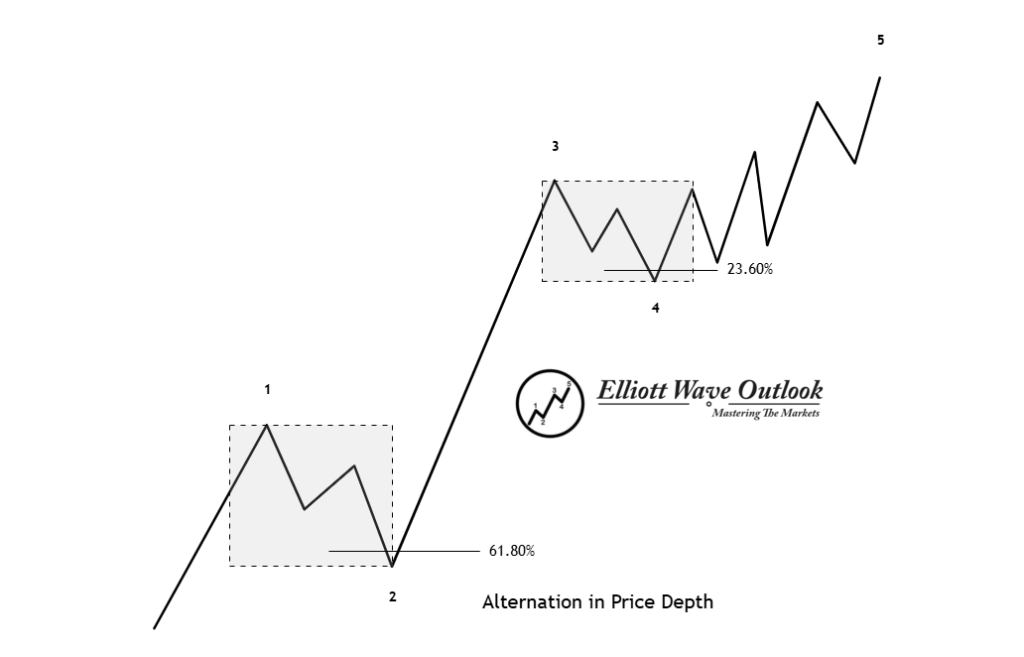
1. Alternation in Price Depth

One correction may retrace a large portion of the previous impulse wave, while the next correction remains relatively shallow.

Example:

  • Wave 2 retraces 61.8% of Wave 1.
  • Wave 4 retraces only 23.6% or 38.2% of Wave 3.
Alternation in Price Depth

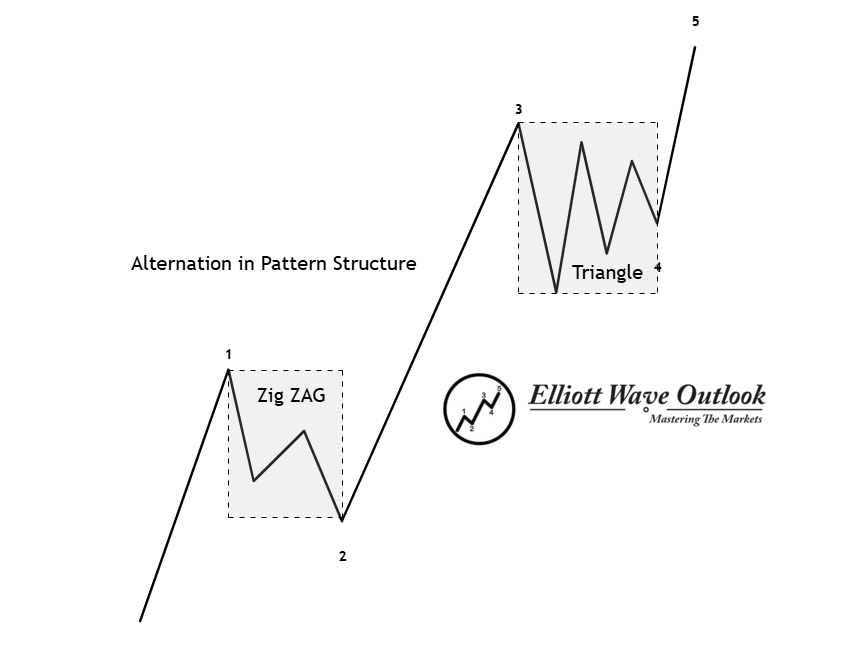
2. Alternation in Pattern Structure

Corrective waves often alternate between different formations.

Common combinations include:

  • Zigzag followed by Flat
  • Flat followed by Triangle
  • Zigzag followed by Complex Correction

This variation is a cornerstone of professional Technical Analysis Elliott Wave techniques.

Alternation in Pattern Structure

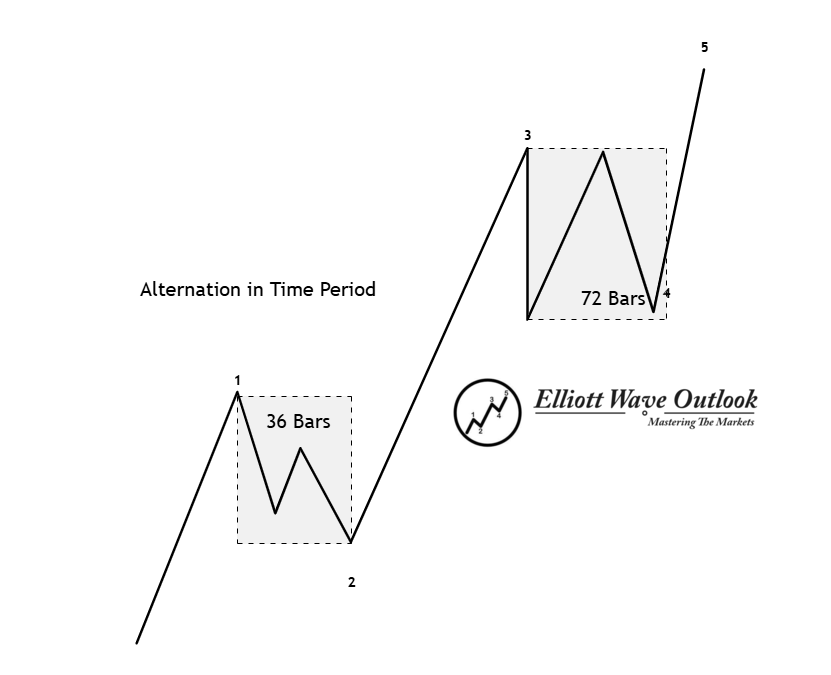
3. Alternation in Time Duration

One corrective wave may complete quickly, while another takes much longer to develop. Time alternation helps traders estimate how long a correction may last before the trend resumes.

Alternation in Time Period

Alternation and Fibonacci Relationships

The concept of Fibonacci Elliott Wave analysis works closely with alternation. Since corrections often follow Fibonacci retracement levels, traders use these levels alongside alternation to identify high-probability reversal zones.

For instance:

  • A deep Wave 2 correction may reach the 61.8% retracement level.
  • Wave 4 may then terminate near the 23.6% or 38.2% retracement level.

Combining Fibonacci ratios with alternation strengthens market forecasts and improves trade entries.

Why Alternation Matters

One of the biggest challenges in Elliott Wave Trading Strategy is identifying where the market is within a wave cycle. Alternation provides valuable clues about what type of correction may occur next.

Benefits of understanding alternation include:

  • Improved Elliott Wave Prediction
  • Better trade entry and exit points
  • Enhanced risk management
  • Increased confidence in wave counting
  • More accurate market forecasting

By applying alternation, traders can prepare for likely market scenarios instead of reacting emotionally to price movements.

Common Mistakes Traders Make

Many traders ignore alternation and assume that future corrections will mirror previous ones. This can lead to:

  • Incorrect wave counts
  • Premature trade entries
  • Poor risk management
  • Missed profit opportunities

Successful traders use alternation as a guideline rather than a rigid rule, combining it with other tools such as trend analysis, Fibonacci retracements, and technical indicators.

Practical Trading Applications

In an Elliott Wave Trading Strategy, alternation serves as a forecasting tool. If Wave 2 has already formed as a sharp correction, traders can anticipate a more sideways Wave 4. This expectation helps avoid premature trades and improves position management.

The principle is widely used across:

  • Elliott Wave Forex Trading
  • Elliott Wave Stock Market analysis
  • Elliott Wave Cryptocurrency Analysis
  • Commodities and indices trading

Whether trading currencies, stocks, or cryptocurrencies, alternation helps traders interpret market structure with greater confidence.

The Alternation Principle is a powerful guideline within Elliott Wave Principle that helps traders understand the dynamic nature of market corrections. By recognizing differences between corrective waves in terms of depth, structure, and duration, traders can improve their Elliott Wave Trading System and make more informed decisions.

The Alternation Principle is a cornerstone of Elliott Wave Theory and plays a crucial role in identifying corrective wave structures. By understanding how corrections alternate in form, time, and depth, traders can improve their Elliott Wave Analysis, make better trading decisions, and enhance market forecasting accuracy. Whether you are involved in Elliott Wave Forex Trading, Elliott Wave Stock Market Analysis, or Elliott Wave Cryptocurrency Analysis, mastering alternation can provide a significant advantage in understanding market cycles and predicting future price action.

For anyone seeking to master Elliott Wave Explained concepts, alternation is an essential tool. Combined with Elliott Wave Indicators, Fibonacci analysis, and proper risk management, it can significantly enhance the effectiveness of Elliott Wave Pattern recognition and market forecasting.
Shopping Cart
Scroll to Top